If you’ve ever squinted at an old gas or electricity meter tucked away in a cupboard, trying to work out whether that’s a 4 or a 9, you’ll understand why smart meters have become such a welcome upgrade for UK households. Since the government-backed rollout began, millions of homes across England, Scotland, and Wales have had smart meters installed, replacing manual readings with automatic, real-time data.
But not all smart meters are created equal. There are different generations, different fuel types, and different payment models — and understanding the differences can help you get the most out of your energy setup, avoid common glitches, and make smarter decisions when switching suppliers. This guide breaks down everything you need to know about smart meters in the UK, from how they work to which type might suit you best.
What Is a Smart Meter?
A smart meter is a digital device that measures your gas and electricity usage and sends readings automatically to your energy supplier, usually every 30 minutes. Unlike traditional meters, which require manual readings (either by you or a meter reader), smart meters communicate wirelessly via a secure national network, eliminating estimated bills and giving you a far more accurate picture of your consumption.
Most smart meter installations come with an in-home display (IHD), a small handheld screen that shows your energy usage in near real-time, often in pounds and pence. This makes it much easier to spot which appliances are costing you the most and to adjust your habits accordingly.
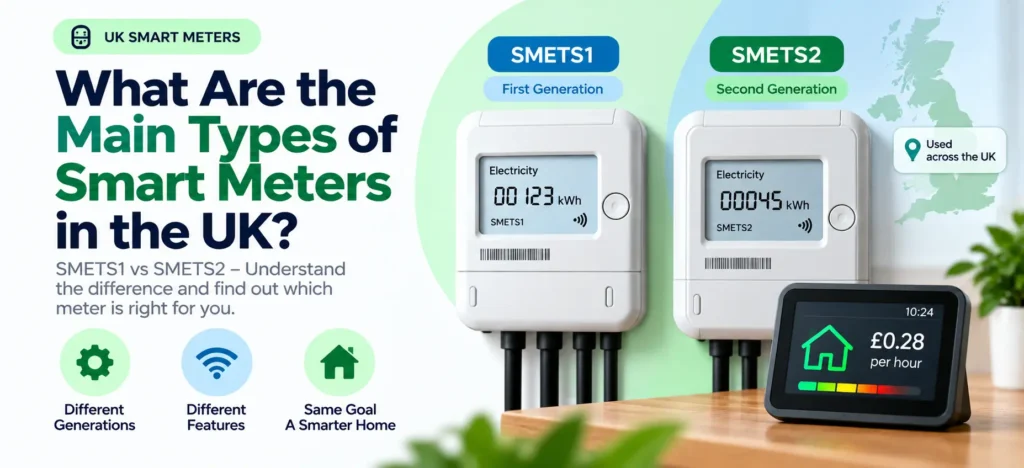
What Are the Main Types of Smart Meters in the UK?
There are two generations of smart meters currently in use across the UK: SMETS1 and SMETS2. SMETS stands for Smart Metering Equipment Technical Specifications, and the number reflects which version of the technical standard the meter was built to.
SMETS1 Smart Meters
SMETS1 meters were the first generation rolled out, starting around 2013. While functional, these early meters had a significant limitation: they were often tied to the supplier that installed them. If you switched energy providers, your SMETS1 meter frequently lost its “smart” functionality and reverted to acting like a traditional meter, requiring manual readings again.
Many SMETS1 meters have since been brought back online and enrolled into the national Data Communications Company (DCC) network, restoring their smart capabilities even after a switch. However, some older units still experience connectivity issues.
SMETS2 Smart Meters
SMETS2 meters are the newer standard, and they were designed specifically to fix the interoperability problem. These meters connect directly to the DCC network rather than to an individual supplier’s system, meaning they retain full smart functionality no matter which supplier you’re with — even if you switch multiple times.
Since 2018, SMETS2 has been the standard meter installed in new smart meter rollouts, and it’s generally considered the more reliable and future-proof option.
SMETS1 vs SMETS2: What’s the Difference?
The core difference between the two comes down to connectivity and supplier independence:
- Network compatibility: SMETS2 meters connect to a universal national network; SMETS1 meters were originally supplier-specific.
- Switching suppliers: SMETS2 meters keep working smoothly after a switch; SMETS1 meters may lose smart functionality unless enrolled onto the DCC network.
- Reliability: SMETS2 is the more modern and stable technology, with fewer reported signal or data issues.
- Availability: Since 2018, most new installations use SMETS2, so if you’ve had a meter fitted recently, it’s very likely SMETS2.
For most households, SMETS2 offers a smoother, more hassle-free experience, particularly if you like to shop around for better energy deals.
Electricity Smart Meters vs Gas Smart Meters
Homes with both electricity and gas typically have two separate smart meters — one for each fuel type — though they’re usually linked to the same in-home display.
- Electricity smart meters track your electricity consumption and, in homes with solar panels or other renewable installations, can sometimes measure energy exported back to the grid.
- Gas smart meters measure gas usage via a valve and sensor system, converting the reading into a format the electricity meter can then transmit alongside its own data (since gas meters typically don’t have a direct network connection of their own).
Both meter types send readings to your supplier automatically, so you get accurate, combined billing without needing to submit separate readings for each fuel.
Smart Credit Meters vs Smart Prepayment Meters
Beyond the SMETS generation and fuel type, smart meters also differ by payment model:
Smart credit meters work like a standard credit account — you use energy throughout the month and are billed afterwards, either monthly or quarterly, based on actual usage.
Smart prepayment meters require you to top up credit in advance, similar to traditional prepayment meters, but with the major advantage that top-ups can usually be done online, via an app, or by text — no more trudging to a shop to top up a physical key or card. Many smart prepayment meters also allow you to switch to credit billing (or vice versa) remotely, without needing an engineer visit, which was often required with older prepayment setups.
How Do Smart Meters Work in the UK?
Smart meters operate using the Wide Area Network (WAN) run by the Data Communications Company, a government-authorised, independent body that manages secure data transfer between meters and energy suppliers nationwide.
Here’s a simplified breakdown of the process:
- Your smart meter records your gas and/or electricity usage at regular intervals (typically every 30 minutes).
- This data is transmitted securely over the DCC network to your energy supplier.
- Your supplier uses this data to generate accurate bills, removing the need for estimated readings.
- Your in-home display pulls this same data to show you real-time usage in near-instant updates.
Because the data goes directly to your supplier, you (in most cases) no longer need to submit manual readings, though you can still do so if your meter temporarily loses signal.
Which Type of Smart Meter Is Best?
For most households, SMETS2 is the better option. It’s more reliable, works seamlessly if you switch suppliers, and represents the current industry standard. If your supplier offers you a choice or you’re due an upgrade, SMETS2 is generally the way to go.
That said, if you already have a SMETS1 meter that’s been enrolled onto the DCC network, it may function just as well day-to-day, and there’s no urgent need to replace it unless you’re experiencing connectivity problems.
As for payment type, smart prepayment meters suit those who prefer to manage spending closely and top up as they go, while smart credit meters suit those who’d rather pay after usage, spread across regular bills.
How to Find Out Which Smart Meter You Have
If you’re not sure what type of smart meter is installed in your home, there are a few simple ways to check:
- Check your in-home display: Some displays show the meter type in their settings menu.
- Look at the meter itself: SMETS1 and SMETS2 meters sometimes have slightly different labelling or model numbers printed on the unit.
- Contact your supplier: Your energy provider can confirm your meter type, generation, and whether it’s currently connected to the DCC network.
- Ask during a switch: If you’re considering switching suppliers, your new provider can usually check compatibility before you commit.
Can You Switch Suppliers With a Smart Meter?
Yes, you can switch energy suppliers with a smart meter installed, and in most cases, your smart functionality will be preserved.
- If you have a SMETS2 meter, switching suppliers should have no impact on your meter’s smart features, as it connects to the national network rather than any single supplier.
- If you have a SMETS1 meter, functionality depends on whether it’s been enrolled onto the DCC network. Many have been, but it’s worth checking with your new supplier beforehand to avoid any temporary loss of smart features.
Either way, switching suppliers is still worthwhile if it saves you money — even in the rare case your meter temporarily reverts to manual readings, most suppliers can get it back online with an update.
Benefits of Having a Smart Meter
There are several practical advantages to having a smart meter installed:
- No more estimated bills — you’re billed for what you actually use.
- Real-time usage tracking via the in-home display, helping you identify energy-hungry appliances.
- Convenient prepayment top-ups without needing to visit a shop.
- Reduced need for manual readings, saving time and hassle.
- Better support for solar panel owners, with some meters tracking energy exported to the grid.
- Easier switching between tariffs or suppliers, especially with SMETS2 meters.
Common Problems With Older Smart Meters
Despite their benefits, some smart meters — particularly older SMETS1 units — can run into issues:
- Loss of smart functionality after switching suppliers, reverting to manual reading mode.
- Signal or connectivity drop-outs, especially in areas with weaker network coverage.
- Display syncing issues, where the in-home display doesn’t update correctly.
- Firmware compatibility problems, particularly with meters that haven’t been updated or enrolled onto the DCC network.
If you’re experiencing any of these issues, contacting your supplier is usually the fastest way to get things resolved, as many problems can be fixed remotely.
Frequently Asked Questions
Do I have to have a smart meter installed?
No, smart meter installation is not legally mandatory in the UK, though suppliers actively encourage it as part of the national rollout.
Are smart meters accurate?
Yes, smart meters are generally highly accurate, removing the guesswork involved in estimated billing.
Do smart meters cost extra to run?
No, there’s no additional charge for having a smart meter, and installation is typically offered free by suppliers.
Can I have a smart meter removed?
Technically yes, though most suppliers will encourage you to keep it, and removal isn’t common practice.
Will a smart meter work during a power cut?
The in-home display may lose power temporarily, but the meter itself typically resumes normal function once power is restored, with any gaps in data usually filled in automatically.
Conclusion
Smart meters have transformed the way UK households track and manage their energy use, cutting out estimated bills and offering far greater transparency over consumption. While SMETS1 meters kicked off the rollout, SMETS2 has become the gold standard thanks to its universal network compatibility and reliability across supplier switches.
Whether you’re on a credit or prepayment plan, understanding your meter type — and how to check it — puts you in a better position to manage your energy costs and make informed decisions when it comes to switching or upgrading.