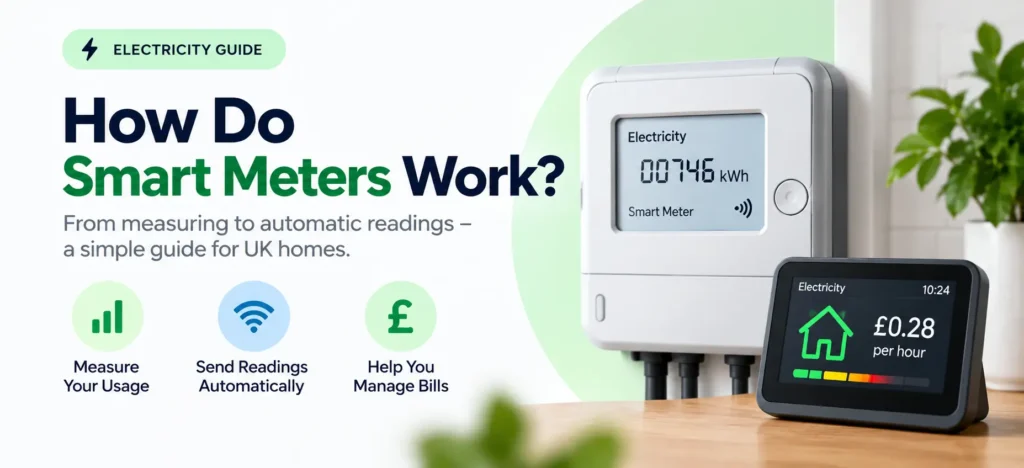
Millions of homes now have an electricity smart meter installed, quietly tracking every unit of power used. But how does a smart meter actually work behind that small digital screen? This guide breaks down the entire process, from measuring electricity to sending automatic readings, so you know exactly what your meter is doing and how it can help lower your bills.
What Is an Electricity Smart Meter?
An electricity smart meter is a digital device that measures, records, and automatically sends your energy usage data to your supplier, replacing the need for manual meter readings. It also connects to an in-home display, giving you real-time visibility into how much electricity you’re using and what it’s costing you.
Unlike an old analog meter with a spinning dial, a smart meter works entirely electronically. It communicates directly with your energy provider over a dedicated wireless network, which means no more estimated bills based on guesswork.
How Does an Electricity Smart Meter Work?
A smart meter works by measuring electricity as it flows into your home, recording that usage in detailed time intervals, and transmitting the data automatically to your energy supplier without any manual input. This three-step process runs continuously in the background, every day of the year.
Measuring Electricity Usage
Inside every smart meter is a sensor that tracks the exact amount of electricity passing through your home’s circuit in real time. This is measured in kilowatt-hours (kWh), the standard unit used on electricity bills. The meter picks up usage from every appliance, light, and device drawing power, giving a precise reading rather than an estimate.
Recording Energy Consumption
Once usage is measured, the smart meter stores it digitally in short intervals, often every 30 minutes. This creates a detailed usage timeline throughout the day, rather than a single number at the end of the month. That level of detail is what makes smart meters far more useful than traditional meters for spotting usage patterns.
Sending Meter Readings Automatically
The final step is automatic transmission. The meter sends stored readings directly to your supplier through a secure wireless network, removing the need for a technician visit or a self-submitted reading. This is the core feature that separates smart meters from traditional ones.
How Does a Smart Meter Send Electricity Readings?
A smart meter sends electricity readings using a dedicated wireless communications network built specifically for utility devices, separate from home Wi-Fi or mobile data. Readings travel from the meter to a secure central data system managed by the energy supplier or a regional data provider.
Because this process is fully automated, there’s no action required from the homeowner. In areas with weaker network coverage, suppliers sometimes install a signal booster to keep the connection stable and readings flowing consistently.
How Often Does a Smart Meter Send Readings?
Most smart meters send readings once a day, though some are configured to transmit more frequently, such as every 30 minutes, depending on the meter type and supplier setup. This regular schedule is what allows suppliers to generate bills based on actual usage instead of estimates.
- Daily transmission – the most common setup for standard billing.
- Half-hourly transmission – used for more detailed usage tracking, often paired with time-of-use tariffs.
- On-demand transmission – readings can sometimes be pulled manually by the supplier if needed.
How Does a Smart Meter Help With Electricity Bills?
A smart meter helps with electricity bills by sending accurate, real-time usage data to your supplier, so bills are based on actual consumption rather than estimates. This eliminates the common problem of underpaying or overpaying and removes the need for manual readings or catch-up bills.
With detailed usage data available, it’s also easier to see exactly where your electricity costs are coming from, whether that’s a specific appliance, a habit, or a spike during certain hours of the day.
How Can You Monitor Your Electricity Usage?
You can monitor your electricity usage through the in-home display that comes with your smart meter, or by checking historical usage data through your supplier’s online account or app. Both tools turn raw meter data into information you can actually act on.
Using the In-Home Display
The in-home display is a small handheld or wall-mounted screen linked to your smart meter. It shows real-time electricity usage, often broken down into simple figures like cost per day or cost so far this month. Seeing this instantly makes it easier to notice how specific appliances affect your usage.
Viewing Your Electricity Usage Over Time
Beyond real-time monitoring, most suppliers offer access to historical usage data through an online account or app. This lets you compare usage across days, weeks, or months, and spot patterns like higher consumption during certain seasons or times of day.
Can Smart Meters Help You Save Electricity?
Smart meters can help you save electricity indirectly by giving you detailed, real-time data that makes it easier to identify wasteful habits and adjust your behavior. The meter itself doesn’t reduce usage, but the visibility it provides often leads to real savings over time.
Common ways households use this data to cut costs include:
- Running high-energy appliances during off-peak hours.
- Identifying and fixing energy-draining devices left on standby.
- Setting daily or weekly usage targets based on the in-home display.
- Comparing usage month to month to catch unusual spikes early.
Smart Meter vs Traditional Electricity Meter
The biggest difference between a smart meter and a traditional meter is automation: smart meters send readings automatically and in detail, while traditional meters rely on manual readings and estimated billing.
| Feature | Smart Meter | Traditional Meter |
| Reading method | Automatic, sent wirelessly | Manual, self-read or technician visit |
| Billing accuracy | Based on actual usage | Often based on estimates |
| Usage detail | Recorded in intervals (e.g., every 30 minutes) | Single monthly total |
| In-home monitoring | Yes, via in-home display | No |
| Risk of human error | Low | Higher |
| Setup | Installed by supplier, digital | Analog, older technology |
What Happens If a Smart Meter Cannot Send a Reading?
If a smart meter cannot send a reading, it continues to record usage data internally and stores it until the connection is restored, at which point the stored readings are usually sent through automatically. This usually happens due to a weak or temporarily lost signal.
If the connection issue continues, your supplier may fall back on estimated billing until the meter reconnects, similar to how traditional meters were historically billed. You can typically still check your usage locally through the in-home display, even if the remote connection is down.
Summary
An electricity smart meter measures your usage in real time, records it in detailed intervals, and automatically sends that data to your supplier, giving you accurate bills and clear visibility into your energy habits. Compared to a traditional meter, it removes guesswork, reduces errors, and puts usage data directly in your hands through an in-home display or online account.
Frequently Asked Questions About Electricity Smart Meters
What happens if a smart meter loses its signal?
If a smart meter loses its signal, it stores usage data internally until the connection is restored. In the meantime, your supplier may issue an estimated bill until automatic readings resume.
Can a smart meter help reduce electricity bills?
A smart meter doesn’t lower usage on its own, but the detailed, real-time data it provides often helps households spot wasteful habits and adjust behavior, which can lead to lower bills over time.
How often does a smart meter send readings?
Most smart meters send readings daily, though some are set up to transmit more frequently, such as every 30 minutes. The exact frequency depends on the meter type and your supplier’s setup.
How does a smart meter measure electricity?
A smart meter measures electricity using an internal sensor that continuously tracks the flow of power into your home. Usage is recorded in kilowatt-hours (kWh) as appliances and devices draw electricity.
Do smart meters automatically send electricity readings?
Yes, smart meters are designed to send readings automatically to your energy supplier through a wireless network. This removes the need for manual readings, technician visits, or estimated bills.
Final Thoughts
Smart meters have changed the way households track and manage electricity use, replacing guesswork with accurate, real-time data. If your home still has a traditional meter, contact your energy supplier to check your eligibility for a free smart meter upgrade and start monitoring your usage more closely today